




| Aliases | BI 456906 |
| Class | GCG/GLP-1 dual agonist |
| Molecular weight (Da) | 4231.6 |
| Half-life (indicative) | ~4 d |
| Research status | In clinical research |
Research context (RUO): Survodutide (BI 456906) is a dual glucagon/GLP-1 receptor agonist studied for obesity and fatty liver disease (MASH). It is supplied exclusively for in-vitro laboratory research and is not intended for human or animal use.
Survodutide research: the dual glucagon/GLP-1 agonist under the microscope
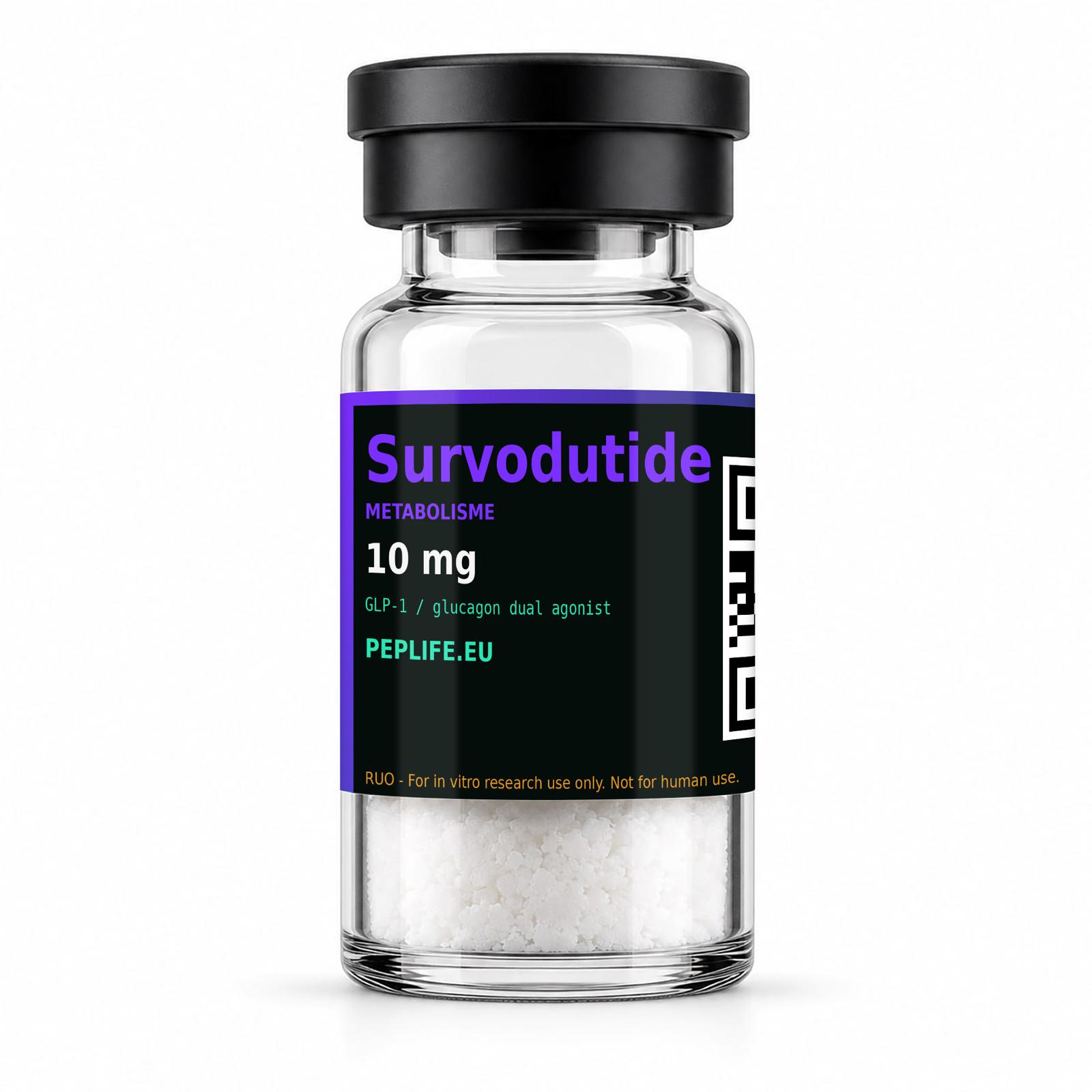
Survodutide research has attracted a lot of attention in recent years, because this molecule takes a different route than the well-known GLP-1 peptides such as semaglutide. Survodutide (development code BI 456906) is a so-called dual or “twincretin” agonist: it simultaneously activates the GLP-1 receptor and the glucagon receptor. That combination makes it an interesting object of study within metabolism research, and explains why it is studied by researchers separately from the single GLP-1 agonists.
What is survodutide?
Survodutide is a synthetic peptide conceptually based on oxyntomodulin, an endogenous gut hormone that naturally acts on both the GLP-1 and the glucagon receptor. The molecule (CAS 2805997-46-8) was developed by Boehringer Ingelheim in collaboration with the Danish company Zealand Pharma. In clinical research, survodutide is dosed weekly, with studied doses rising to approximately 4.8 to 6.0 mg per week. Within the broader class of incretin peptides, survodutide stands out for its dual mechanism of action, which makes it a popular subject in comparative laboratory research. Anyone who wants to place the various incretins side by side will find more context in our pillar on comparing GLP-1 peptides.
How does survodutide work? — the mechanism
The core of survodutide research revolves around that dual receptor action. The GLP-1 receptor is familiar from other incretins: its activation is associated in studies with lower food intake and slower gastric emptying. Survodutide adds the glucagon receptor to this. Glucagon is traditionally known as the hormone that raises blood sugar, but in metabolic research the attention is mainly on another property: activation of the glucagon receptor was associated in preclinical models with higher energy expenditure and increased fat breakdown in the liver. Researchers are studying whether it is precisely the combination of both signalling pathways that produces a stronger metabolic effect than GLP-1 activation alone. This hypothesis — that “two receptors are better than one” — forms the common thread through virtually all survodutide studies.
What is survodutide studied for?
Survodutide is studied within two major areas of research, with the published phase 2 data giving a concrete picture of what researchers reported:
- Obesity and fat loss: In a randomised, placebo-controlled phase 2 study (published in The Lancet Diabetes & Endocrinology, 2024, 386 participants), researchers reported an average weight loss of 14.9% at the highest dose (4.8 mg) after 46 weeks, compared with 2.8% in the placebo group. In the same study, 55% of participants in the highest-dose group achieved a weight reduction of at least 15%.
- Fatty liver (MASH): In a phase 2 study published in The New England Journal of Medicine (2024), survodutide was studied in adults with MASH (metabolic dysfunction-associated steatohepatitis) and liver fibrosis. Researchers reported that 83% of treated participants showed a histological improvement of MASH after 48 weeks without worsening of fibrosis, compared with 18.2% in the placebo group.
- Metabolic and cardiovascular parameters: In follow-up analyses of the obesity study, researchers also examined effects on blood pressure and other metabolic markers, which further filled in the picture of a broad metabolic activity profile.
On the basis of these phase 2 results, survodutide research programmes have progressed to larger-scale phase 3 studies, both for obesity and for MASH. For anyone wishing to position survodutide alongside other metabolic candidates, a comparison with the triple agonist retatrutide research and with the broader fat-loss peptides clarifying.
Survodutide in laboratory research: handling & reconstitution
Like most peptides, survodutide is supplied as a freeze-dried (lyophilised) powder that must be reconstituted before in-vitro use. In laboratory protocols the powder is usually dissolved in bacteriostatic or sterile water, after which it is stored cold to preserve peptide stability. The precise procedure is further elaborated in our pillars reconstitute peptides and dissolve peptide: which liquid. Careful handling is important in research, because degradation can affect the reliability of in-vitro results.
Quality & purity
Every relevant batch of survodutide is independently HPLC-tested by an external laboratory; the certificate of analysis (CoA) is publicly verifiable per batch. For comparative laboratory research, a demonstrably high purity is essential — contaminants or degradation products can distort in-vitro outcomes. At Peplife the origin of every batch is therefore traceable and the reported purity is confirmed by an external party, so that research results remain reproducible.
Frequently asked questions about survodutide
What is the difference between survodutide and semaglutide?
Semaglutide is a single GLP-1 receptor agonist, whereas survodutide activates both the GLP-1 and the glucagon receptor. Researchers study whether that extra glucagon component leads to a stronger effect on energy expenditure and fatty liver. They are therefore different classes within incretin research.
Why is survodutide studied specifically for fatty liver disease?
The glucagon component is associated in preclinical research with increased fat breakdown in the liver. That makes survodutide a logical candidate in MASH research, where the phase 2 results from 2024 (NEJM) were described as notably positive.
Who develops survodutide?
Survodutide (BI 456906) is developed by Boehringer Ingelheim in collaboration with Zealand Pharma. The development code BI 456906 refers to Boehringer Ingelheim.
Is survodutide an approved drug?
No. Survodutide is in clinical research phases and is not approved by the EMA, FDA or other authorities. At Peplife it is offered exclusively for in-vitro laboratory research (Research Use Only).
Can I buy survodutide for research?
Survodutide is available from Peplife as RUO research material, HPLC-tested and with CoA per batch. It is intended exclusively for laboratory research, not for human or animal use.
How does survodutide relate to tirzepatide and retatrutide?
Tirzepatide combines GLP-1 with GIP, retatrutide adds glucagon on top of that (triple agonist), and survodutide focuses specifically on the GLP-1/glucagon combination. Each of these molecules is studied in its own studies for metabolic outcomes.
Read more & research at Peplife
- Research Survodutide at Peplife
- View all metabolism peptides
- Research Retatrutide at Peplife
- Research Tirzepatide at Peplife
- comparing GLP-1 peptides
- Retatrutide research: the triple agonist
- Fat-loss peptides in research
Sources: le Roux et al., survodutide phase 2 obesity, Lancet Diabetes Endocrinol 2024 (PubMed) · Sanyal et al., survodutide phase 2 MASH & fibrosis, NEJM 2024 (PubMed) · Boehringer Ingelheim — phase 2 MASH data · Survodutide — overview (Wikipedia)
Research Use Only. All products are supplied exclusively for in vitro laboratory research. Not intended for diagnostic or therapeutic use in humans or animals, and not approved by the EMA or FDA.
Survodutide for laboratory research: HPLC-tested, CoA per batch and discrete shipping within the EU.