




| Class | Bioregulator/immune |
| Molecular weight (Da) | mixture (≤10 kDa) |
| Half-life (indicative) | not published |
| Research status | Preclinical / RUO |
Research context (RUO): Thymalin is a thymus peptide preparation from the Russian bioregulator research line studied for immune modulation and ageing. It is supplied exclusively for in-vitro laboratory research and is not intended for human or animal use.
Thymalin research: the thymus bioregulator peptide
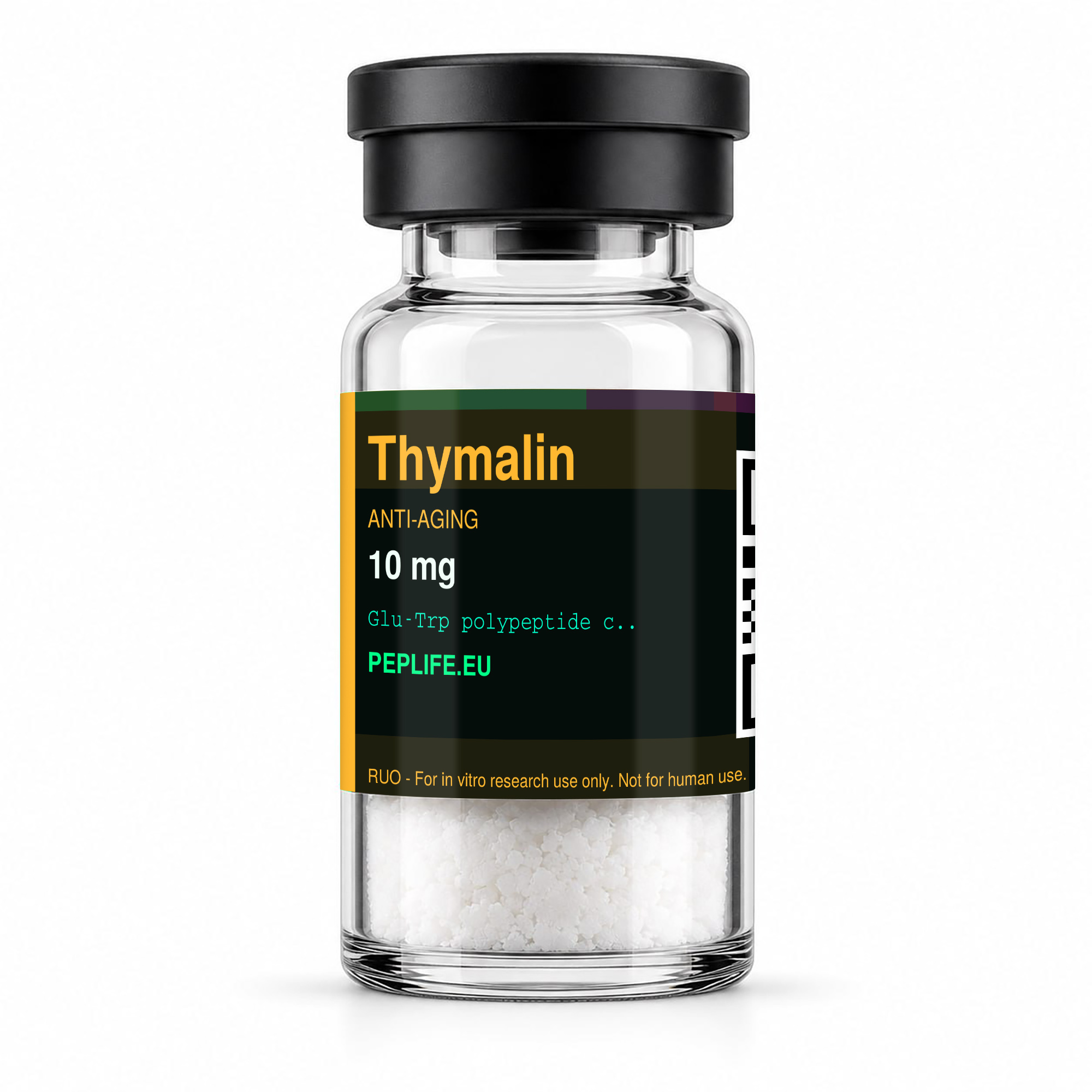
Het Thymalin research centres on one of the most-studied peptide preparations from the thymus (sweetbread): a complex of polypeptide fractions that has been studied since the 1980s by the Russian research group around Vladimir Khavinson for immunomodulation and biological ageing. Unlike most peptides that rely on a single short amino-acid chain, Thymalin is a preparation of multiple thymus polypeptides — and it is precisely that background that makes it interesting for laboratories wishing to investigate the concept of “bioregulation”.
What is Thymalin?
Thymalin is a polypeptide preparation originally isolated from the thymus of calves. The thymus is the organ in which T-lymphocytes (a central type of white blood cell) mature; with ageing this organ shrinks and immune capacity declines. Thymalin belongs to the class that researchers peptide bioregulators call: substances that, according to the Khavinson hypothesis, would steer gene expression and protein synthesis in specific tissues towards a younger functional level. From this line of research, shorter synthetic peptides later emerged as well, such as Vilon (Lys-Glu) and Thymogen (Glu-Trp), which are studied as simplified variants of the thymus effect. Thymalin itself, however, remains the classic, frequently cited reference preparation within this tradition.
How does Thymalin work? — the mechanism
The presumed mechanism of action is immunomodulatory: in research, Thymalin is associated with a normalising effect on T-cell immunity, natural killer (NK) cells and phagocytosis (the “eating up” of pathogens by immune cells). Instead of one-sidedly stimulating the immune system, researchers often describe the effect as regulating — the return of a dysregulated immune profile to a more balanced level. In the review article Peptide Regulation of Ageing (Arutyunyan et al., 2025), authors place Thymalin within a broader class of thymus and pineal-gland peptides that, according to the hypothesis, would act as geroprotectors (ageing inhibitors) via regulation of gene expression and protein synthesis. Important: this remains a research hypothesis, not a proven therapy.
What is Thymalin studied for?
The literature around Thymalin concentrates on a few clear areas of research. In every case it concerns observations in studies and models — not applications in the reader.
- Immunomodulation: in a randomised study in severely ill elderly COVID-19 patients (Kuznik & Khavinson et al., 2021, Advances in Gerontology) researchers reported a strong increase in lymphocytes, T and B lymphocytes and NK cells after a 10-day protocol of 10 mg Thymalin compared with the control group.
- Ageing and lifespan: in a long-running clinical study of 6–8 years in 266 older individuals (Khavinson & Morozov, 2003, Neuroendocrinology Letters) Thymalin was associated with a 2.0–2.1-fold decrease in mortality; combined with the pineal-gland preparation Epithalamin and repeated annually, this rose, according to the authors, to a 4.1-fold decrease over six years.
- Resistance to infections: in the same long-term study, researchers described a 2.0–2.4-fold decrease in acute respiratory infections in the treated groups.
- Homeostasis and ageing markers: researchers reported an improved “stability of homeostasis” and a more favourable course of age-related conditions, which is studied as a measure of biological ageing.
Thymalin in laboratory research: handling & reconstitution
Thymalin is supplied as a freeze-dried (lyophilised) powder and reconstituted in the laboratory with a suitable liquid before it is studied in in-vitro assays. Which liquid and concentration are appropriate depends on the research protocol; background on this can be found in our pillar reconstitute peptides and in which liquid you use to dissolve peptides. As a peptide preparation, Thymalin is sensitive to heat and repeated freeze-thaw cycles; storing it cool and dark is described in the literature as standard practice to limit degradation.
Quality & purity
Because a peptide preparation only yields reliable research results when the composition is correct, every relevant batch is independently HPLC-tested by an external laboratory; the accompanying certificate of analysis (CoA) is publicly verifiable per batch. This allows researchers to check the identity and purity before including the material in an assay. How we deal with deviating batches, you can read in why we rejected a batch.
Frequently asked questions about Thymalin research
What exactly is Thymalin?
Thymalin is a thymus peptide preparation: a complex of polypeptide fractions originally isolated from the calf thymus. It is studied in laboratory research as an immunomodulator and bioregulator within the Khavinson research line.
How does Thymalin differ from Thymosin Alpha-1?
Thymosin Alpha-1 is one defined synthetic peptide of 28 amino acids, whereas Thymalin is a mixture of thymus polypeptides. Both are studied for immune function; a comparison can be found at Thymosin Alpha-1 in our catalogue.
Why is Thymalin associated with ageing?
Because the thymus shrinks with age and immunity weakens, scientists study whether thymus peptides influence that process. In the long-term research by Khavinson and Morozov (2003), Thymalin was associated with lower mortality and better immune markers in the elderly.
Is Thymalin often combined with Epitalon in research?
Yes. In the bioregulator tradition, the thymus line (Thymalin) is often studied together with the pineal-gland line, of which Epitalon is the best-known synthetic variant. In the 2003 study, it was precisely the combination that was associated with the strongest effect on mortality.
Is Thymalin approved for human use?
No. In the EU, Thymalin is not registered or approved by the EMA or the NVWA. At Peplife it is supplied exclusively for in-vitro laboratory research (Research Use Only).
How do I verify the purity of Thymalin?
Through the batch-specific HPLC certificate of analysis (CoA) from an independent laboratory, which documents the identity and purity of the preparation supplied.
Read more & research at Peplife
- Research Thymalin at Peplife
- View all anti-aging peptides
- Longevity peptides: what research shows
- Research Thymosin Alpha-1
- Research Epitalon
- Thymosin alpha-1 vs thymalin
Sources: Khavinson & Morozov, 2003 — Neuroendocrinology Letters (PubMed) · Kuznik, Khavinson et al., 2021 — Advances in Gerontology · Arutyunyan et al., 2025 — Peptide Regulation of Ageing, Current Aging Science
Research Use Only. All products are supplied exclusively for in vitro laboratory research. Not intended for diagnostic or therapeutic use in humans or animals, and not approved by the EMA or FDA.
Thymalin for laboratory research: HPLC-tested, a verifiable CoA per batch and discreet EU shipping.