




| Aliases | Aviptadil |
| Class | Neuropeptide (VPAC) |
| Molecular weight (Da) | 3326.8 |
| Half-life (indicative) | ~1–2 min |
| Research status | In clinical research |
Research context (RUO): VIP (Vasoactive Intestinal Peptide) is a neuropeptide of 28 amino acids studied in laboratory research for immune modulation, inflammation regulation and the circadian system. It is supplied exclusively for in-vitro laboratory research and is not intended for human or animal use.
VIP peptide research: immune modulation, inflammation and the biological clock
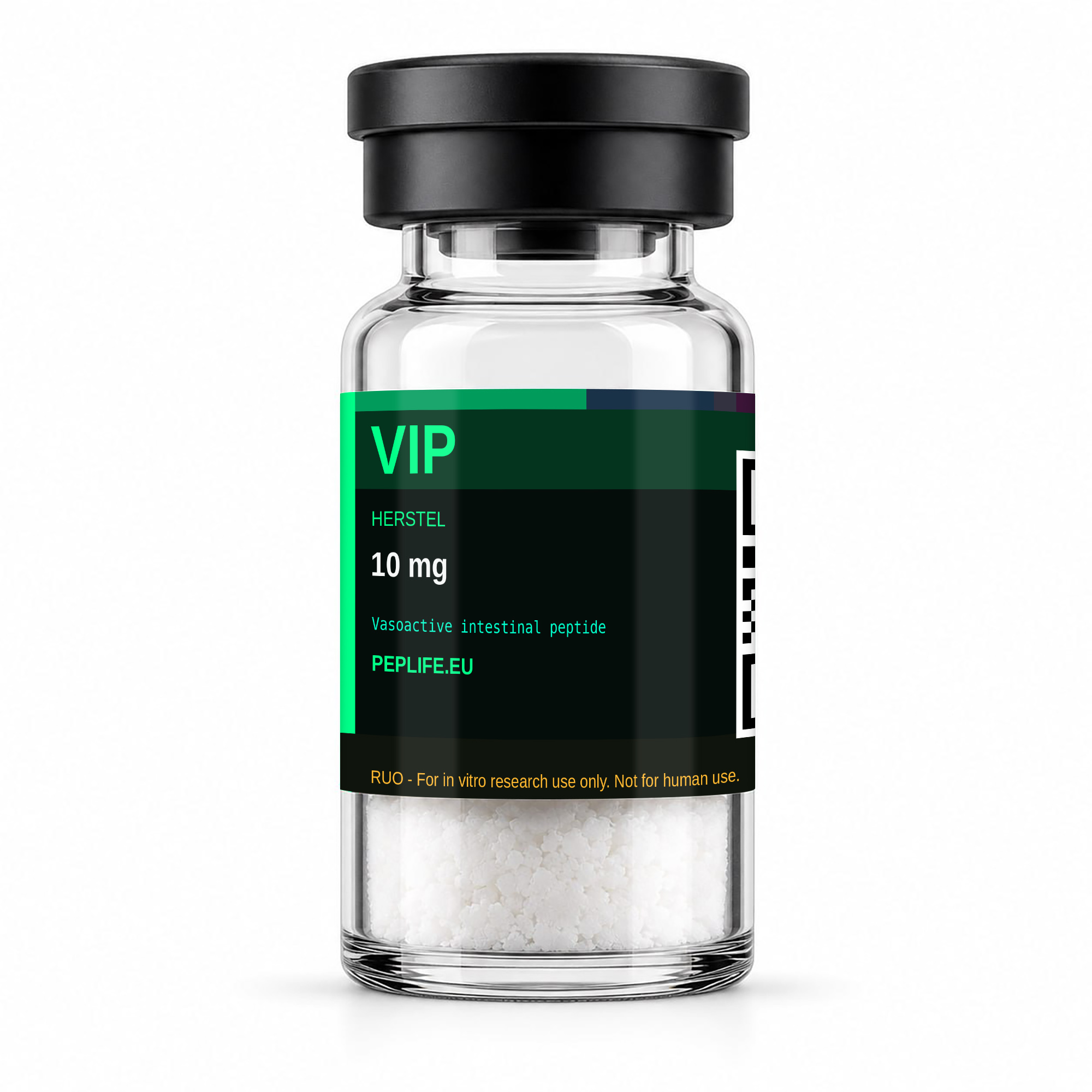
VIP peptide research has attracted a lot of attention in recent years, because this vasoactive intestinal peptide appears to work simultaneously on an unusually broad front: it touches the nervous system, the immune system and circadian (“biological clock”) regulation alike. VIP was originally discovered in the gut, where it dilates the blood vessels — hence the name — but researchers now know that the peptide occurs as a signalling molecule throughout the body. In this article we set out what VIP exactly is, how the mechanism is described in studies, and what it is currently being studied for preclinically and clinically.
What is VIP (Vasoactive Intestinal Peptide)?
VIP is a neuropeptide that belongs to the so-called secretin-glucagon family. It consists of 28 amino acids and acts via three receptors: VPAC1, VPAC2 and (to a lesser extent) PAC1. These receptors are found not only on nerve cells, but also on immune cells such as macrophages, dendritic cells and T cells, and on cells in the brain nucleus that drives the day-night rhythm. It is precisely this broad receptor distribution that explains why VIP appears to influence so many different systems at once in research. Because the body produces VIP naturally, it is often described in the literature as an endogenous, “pleiotropic” (multiply active) signalling molecule.
How does VIP work? — the mechanism in research
The best-studied working principle of VIP is that of a anti-inflammatory and immune-regulating molecule. When VIP binds to the VPAC receptors on immune cells, this activates the cAMP signalling route inside the cell. In preclinical studies this inhibits the production of pro-inflammatory messengers such as TNF-alpha, IL-6 and IL-12, while stimulating the production of inflammation-dampening substances (such as IL-10). In a widely cited review article on the immunomodulation of innate immunity, researchers describe how VIP shifts the balance in macrophages and dendritic cells towards a less pro-inflammatory state. In addition, models describe that VIP can steer naive T cells towards regulatory T cells (Tregs) — cells that curb overactive immune reactions. This “Th1-to-regulation” effect is a recurring theme in VIP peptide research.
What is VIP researched for?
Because of that broad activity profile, VIP is studied in diverse research areas. Important: the points below describe what studies report, not what the peptide would do in a user.
- Immunomodulation & inflammation: in preclinical autoimmune and inflammation models, VIP was associated with dampening chronic inflammatory reactions and promoting immune tolerance.
- Sarcoidosis: in a phase II clinical study from 2010 (Prasse et al.), twenty patients with active sarcoidosis received inhaled VIP for four weeks; researchers reported an increase in regulatory T cells and a lowered TNF-alpha production in lung lavage fluid — the first evidence of an immune-regulating effect of VIP in humans.
- Circadian system: in the suprachiasmatic nucleus (SCN), the “master clock” of the brain, VIP proves indispensable, via the VPAC2 receptor, for keeping the clock cells synchronised. In mouse research, animals without VIP lost their stable day-night rhythm.
- CIRS & water-damaged-building research: Within the (still limited and partly controversial) research into Chronic Inflammatory Response Syndrome, VIP is studied as a marker and intervention in persistent inflammatory processes.
- Neuroprotection: because of its inflammation-dampening action in the brain, VIP is also studied in neuro-inflammatory models.
VIP in laboratory research: handling & reconstitution
VIP is supplied as a freeze-dried (lyophilic) powder that is reconstituted in the research setup, usually with bacteriostatic or sterile water. As a relatively large peptide, VIP is sensitive to repeated freezing/thawing and to degradation at room temperature, so cool storage and careful aliquoting are common in protocols. For the practical side of reconstitution and dilution, our pillar reconstituting peptides and which liquid you use to dissolve a peptide a useful starting point.
Quality & purity
Every relevant batch of VIP is independently HPLC-tested by an external laboratory; the certificate of analysis (CoA) is publicly verifiable per batch. For a large, sensitive peptide like VIP, that verification is extra relevant, because degradation products and impurities can affect the reproducibility of in-vitro experiments. If you want to see how strict we are on purity, read why we rejected a batch.
Frequently asked questions about VIP peptide research
What is VIP (Vasoactive Intestinal Peptide)?
VIP is a neuropeptide of 28 amino acids that acts via the receptors VPAC1, VPAC2 and PAC1. In research it is studied for immune modulation, inflammation regulation and the circadian clock. It is supplied exclusively for laboratory research.
What is VIP researched for?
VIP peptide research focuses, among other things, on immune modulation and inflammation, sarcoidosis, the circadian (day-night) system via the VPAC2 receptor, and on CIRS. All findings come from preclinical and early clinical studies.
Is VIP the same as aviptadil?
Aviptadil is a synthetic form of VIP that has been studied in clinical research (among others in respiratory failure). Chemically it corresponds to the natural VIP peptide; the name “aviptadil” refers to the pharmaceutical variant.
How does VIP act on the immune system?
In studies, VIP binds to VPAC receptors on immune cells and, via the cAMP route, inhibits pro-inflammatory substances such as TNF-alpha, while promoting regulatory T cells and inflammation-dampening signals. This has been described in preclinical models and one clinical sarcoidosis study.
What does VIP have to do with the circadian rhythm?
In the suprachiasmatic nucleus of the brain, VIP synchronises the individual clock cells via the VPAC2 receptor. Mouse research showed that without VIP the day-night rhythm becomes unstable.
May I use VIP?
No. VIP at Peplife is intended exclusively for in-vitro laboratory research (Research Use Only) and not for human or animal use, diagnostics or therapy.
Read more & research at Peplife
- VIP (Vasoactive Intestinal Peptide) research at Peplife
- View all immune peptides
- Research Thymosin Alpha-1 — immune peptide
- Research LL-37 — antimicrobial peptide
- Reconstituting peptides: step by step
Sources: Prasse et al., Am J Respir Crit Care Med 2010 — Inhaled VIP in sarcoidosis · Immunomodulation of innate immune responses by VIP (Clin Exp Immunol 2009) · Delgado & Ganea — VIP in inflammation and autoimmunity · Aton et al., Nat Neurosci 2005 — VIP and circadian synchrony in clock cells
Research Use Only. All products are supplied exclusively for in vitro laboratory research. Not intended for diagnostic or therapeutic use in humans or animals, and not approved by the EMA or FDA.
VIP from Peplife is HPLC-tested, with a per-batch verifiable CoA and discrete EU shipping.